Showing posts with label the word of the day. Show all posts

09 October 2008

about years...

a gap year- taking a gap-year, year out or career break
A gap year (also known as "year out", "year off", "deferred year", "bridging year", "overseas experience", "time off" and "time out") is a term that refers to a prolonged period (often, but not always, a year) between a life stage. The most popular gap years are taken pre or during matriculation in a university or college, between college and graduate school and a profession, during a career change, pre or post marriage or having a first child and pre or post retirement. It is generally a practice undertaken by those from developed countries.
a year off
a sabbatical year- un año sabático
leap year- un año bisiesto
freshman year (university, school)nmprimer año (de estudios, universidad)

solar yearnmaño solar
lunar yearnmaño solar
seven-year itch
sensación de monotonía y aburrimiento tras estar siete años con la misma pareja

Alien says to man walking dog:
"I'm not an ambassador from my planet, I'm on my gap year."

05 October 2008

errand

errand ['erənd] nombre recado
to run an errand, hacer un recado
Friday is here. It's the day where I get to spend time reading and running errands.

.n.
1 ver·rand (rnd)
a. A short trip taken to perform a specified task, usually for another.
b. The purpose or object of such a trip: Your errand was to mail the letter.
2. Archaic
a. A mission; an embassy.
b. An oral message that has been entrusted to one.

[Middle English erand, from Old English rend.]
The American Heritage®

errand
[ˈɛrnd] nrecado, mandado;
to run errands → hacer recados;
errand of mercy → misión f de caridad
Collins Spanish Dictionary & Grammar

04 October 2008

moan-moaning


stop meaning mr. grumble...
(deje de quejarse, lamentarse, mr. grumble)

moan [məʊn]
I nombre
1 gemido: his moans became very loud, sus gemidos se hicieron muy altos
2 familiar queja
II verbo intransitivo
1 gemir
2 familiar quejarse [about, de]: she's always moaning about her daughter, siempre se está quejando de su hija


grumble ['grʌmbəl]
I verbo intransitivo refunfuñar: he's always grumbling about the weather, siempre está quejándose del tiempo
II nombre queja

15 September 2008

gingerly

gin·ger·ly (jnjr-l)
adv.
With great care or delicacy; cautiously.
adj.
Cautious; careful.

[Possibly alteration of obsolete French gensor, delicate, from Old French, comparative of gent, gentle; see gent1.]

ginger·li·ness n.

The American Heritage® Dictionary of the English Language, Fourth Edition copyright ©2000 by Houghton Mifflin Company. Updated in 2003. Published by Houghton Mifflin Company. All rights reserved.


gingerly
Adverb
carefully or cautiously: she sat gingerly on the edge of the chair [perhaps from Old French gensor dainty]

Collins Essential English Dictionary 2nd Edition 2006 © HarperCollins Publishers 2004, 2006

ThesaurusLegend: Synonyms Related Words Antonyms
Adj.1.gingerly - with extreme care or delicacy; "they proceeded with gingerly footwork over the jagged stones"; "the issue was handled only in a gingerly way"- W.S.White
cautious - showing careful forethought; "reserved and cautious; never making swift decisions"; "a cautious driver"
Adv.1.gingerly - in a gingerly manner; "gingerly I raised the edge of the blanket"
Based on WordNet 3.0, Farlex clipart collection. © 2003-2008 Princeton University, Farlex Inc.

gingerly

Collins Essential Thesaurus 2nd Edition 2006 © HarperCollins Publishers 2005, 2006

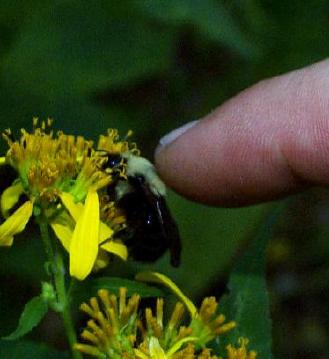
No, I'm not mashing this bumblebee's face into the flower.
I'm gingerly petting it with my finger.


12 September 2008

amid or amidst


amid or amidst
preposition 1. during, among, at a time of, in an atmosphere of
preposition 2. in the middle of, among, surrounded by, amongst, in the midst of, in the thick of

Collins Essential Thesaurus 2nd Edition 2006 © HarperCollins Publishers 2005, 2006

amid
prep amid, amidst [əˈmid(st)]
in the middle of; among Amid all the confusion, the real point of the meeting was lost; amidst the shadows.
Password English Learner’s Dictionary © 1986-2008 K Dictionaries Ltd and partners. All rights reserved.

11 September 2008

tantrum


berrinche, pataleta

Jack had (or threw) a tantrum
Jack tuvo una pataleta, un berrinche
Why did we only divert our attention to Jack when he threw a tantrum after realizing his sister's absence?

07 September 2008

stillness

stillness ['stɪlnɪs] nombre
1 tranquilidad
2 silencio


There are many kinds of stillness. And none of them are still.

The stillness of glaciers, of deep rivers; of a Southern swamp.

All these are in motion; cutting through rock, changing continents; eating the earth, moving the world from one place to another and back. The stillness of fog, of dark, of a woman in thought.

All objects hide one thing and reveal another.


01 September 2008

callow

callow • \KAL-oh\ adjective
: lacking adult sophistication : immature

Example Sentence:
"Back when I was a callow college student," said Emma, "I paid little attention to the advice given to me by my professors."

Did you know?

You might not expect a relationship between "callow" and baldness, but that connection does in fact exist. "Callow" comes from "calu," a word that meant "bald" in Middle English and Old English. By the 17th century, "callow" had come to mean "without feathers" and was applied to young birds not yet ready for flight. The term was also used for those who hadn't yet spread their wings in a figurative sense. "Callow" continues to mean "inexperienced" or "unsophisticated" today.

Xanadu

Xanadu • \ZAN-uh-doo\ noun
: an idyllic, exotic, or luxurious place

Example Sentence:
To Arthur, the beach house was a Xanadu, the perfect spot for the romantic tropical vacation he had dreamed of for years.

Did you know?
"In Xanadu did Kubla Khan / A stately pleasure-dome decree." Those lines are from the poem "Kubla Khan" (published in 1816) by Samuel Taylor Coleridge. Coleridge's fantastic description of an exotic utopia fired public imagination and ultimately contributed to the transition of "Xanadu" from a name to a generalized term for an idyllic place. The Xanadu in the poem was inspired by Shang-tu, the summer residence of Mongolian general and statesman Kublai Khan (grandson of Genghis Khan). You might also recognize "Xanadu" as the name of the fantastic estate in Orson Welles's 1941 film Citizen Kane.

Oldster

oldster • \OHLD-ster\ noun
: an old or elderly person

Example Sentence:
More and more oldsters are embracing the Internet and connecting and interacting using social networking Web sites.

Did you know?
"Youngster" has been used since the 16th century as a word for a young person with a lot of spunk. It has also long been used by maritime people as a word for a midshipman who has served less than four years. This use is connected with the Dutch word "younker," which, like "youngster," refers to a young person as well as a young seaman.
"Oldster" came about as a word used to differentiate the inexperienced midshipmen, or youngsters, from the experienced ones.
To be exact, an oldster is a midshipman of four years' standing.
Charles Dickens gets credit for the earliest known use of "oldster" in the general sense of "an old person." In his 1848 novel Dombey & Son he wrote,
"Her eyes would play the Devil with the youngsters before long -- 'and the oldsters too, Sir, if you come to that,' added the Major."

Epigone

epigone • \EP-uh-gohn\ noun
: follower, disciple; also : an inferior imitator
Example Sentence:
No one can accuse Lara of being an epigone; her artistic style is uniquely her own!

Did you know?
English borrowed "epigone" from German in the 19th century.
The Germans themselves had taken the word from the Latin "epigonus," which means "successor."
The Latin term followed the Greek "epigonos," which was often used in plural to designate the sons of seven legendary Greek leaders who were defeated at Thebes.
"Epigonos" in turn came from the Greek verb "epigignesthai," meaning "to be born after."
"Epi-" can mean "after," and "gignesthai" means "to be born."

Belvedere

belvedere • \BEL-vuh-deer\ noun
: a structure (as a cupola or a summerhouse) designed to command a view
example sentence:
On summer evenings, guests at the estate often joined their hosts in the belvedere to watch the sunset.

Did you know?
It is said that beauty is in the eye of the beholder -- and someone with a belvedere will likely have a great deal of beauty to behold. Given the origins of the word, "belvedere" is the ideal term for a building (or part of a building) with a view; it derives from two Italian words, "bel," which means "beautiful," and "vedere," which means "view." The term has been used in English since at least 1593.

31 August 2008

nadir

The Word of the Day for August 31, 2008 is:

nadir • \NAY-deer\ noun
1 : the point of the celestial sphere that is directly opposite the zenith and vertically downward from the observer
*2 : the lowest point

Example Sentence:

Ironically, the high point of the novel occurs when the protagonist reaches her nadir, for only then does she arouse our empathy and emotional involvement.

Did you know?

"Nadir" is part of the galaxy of scientific words that have come to us from Arabic, a language that has made important contributions in the vocabulary of mathematics, astronomy, medicine, and chemistry. "Nadir" derives from an Arabic word meaning "opposite" -- the opposite, that is, of the "zenith," which names the highest point of the celestial sphere, the one vertically above the observer. (The word "zenith" itself is a modification of another Arabic word that means "the way over one's head.") The English poet John Donne is first on record as having used "nadir" in the figurative sense of "lowest point" in a sermon he wrote in 1627.